
2024 was a busy year. Between the family and farm I didn’t read or write as much as I normally do, but I still read several great books and wrote some stories and poems. My first novel An American Band came out in February after about five years of writing and another three of finding a publisher. I also wrote the first short story I’m really proud of, which High Horse Magazine published in December.
So I’d like to share some of the best things I read this year. I started the year with John Williams and Thomas McGuane and ended with an indie poetry collection and Beowulf. All over the map, how I like it.
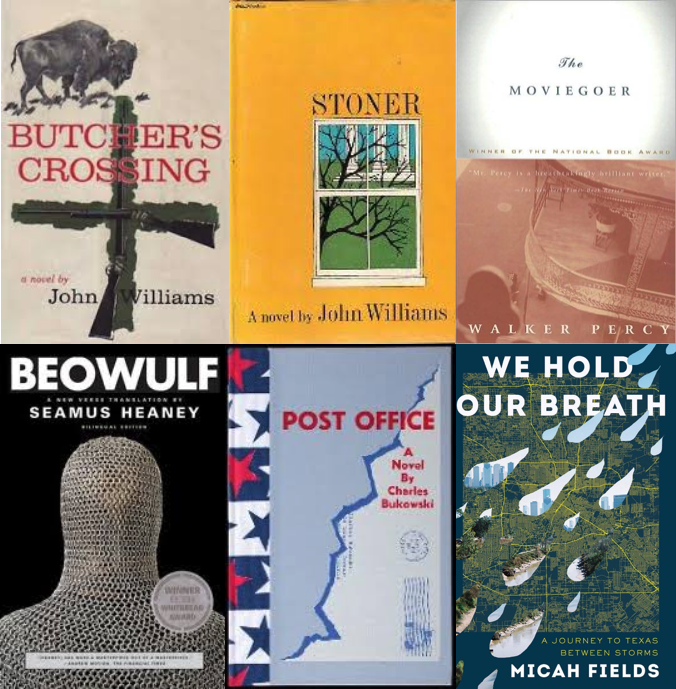
Stoner was a quiet novel but one of the best I’ve ever read. Williams handles the life of English professor William Stoner with such skill and tenderness. There’s nothing too dramatic in this book. The protagonist, while of strong character, is not a brave man and rarely takes drastic measures. His life from the outside–an unhappy marriage and a career that never advances far–could be rightfully called a failure. But it’s inside the character of Stoner where we find depth and passion that the outside world never knows. This comes out in his work–his passion for literature–and in his relationship with his daughter, which his wife degrades, and finally in an affair with a grad student. Stoner is frustratingly passive and often falters by choosing not to respond to people taking advantage of him. But that’s the point. We’re supposed to sit with this passionate yet stoic man, and no matter how different you are from Stoner, you feel what happens to him in this book. As the author once complained of changes in the way literature is taught in school, “…as if a novel or a poem is something to be studied and understood rather than experienced.” Reading Stoner is an experience.
Butcher’s Crossing was the other novel I read by John Williams this year. He wrote only four novels, and I intend to read all of them at some point. This book is also deserving of top honors, though such a different world he created here than in Stoner. The book (published 5 years before Stoner) is once again bolstered by William’s strong prose, simply worded yet with a depth many authors twist themselves in knots trying to get to. So many of the great stories are about man versus nature, and this does it as well as any of them. Knowing it was about the tail end of buffalo hunting in America–and the history of how the hunters left so many of those great beasts to rot on the plains, taking only their hides for profit–I expected more of a scolding tone to this book, more demonization of the hunters. But luckily Mr. Williams wrote this book instead of a less talented writer like me. He writes these characters so well, from the young and naive Will Andrews to the drunk zealous Charlie Hoge to Miller, the grizzled leader who sees his way of life coming to an end. Like the Westerns of Cormac McCarthy (whose masterpiece Blood Meridian was influenced by this book), there is little interiority to be found in his characters here. The hunts are clear-eyed accounts of slaughter. There is no preaching or condemnation to be found. And when you portray what’s going on with such proficiency and palpable strain, you don’t need to tell the reader what to think. A haunting, elemental portrayal of man’s struggle to master the wild.
We Hold Our Breath: A Journey to Texas Between Storms was an audiobook I listened to this summer. It’s probably the most flawed of my top picks, but the subject and writing style (and recent release) made it stand out. It starts with a captivating summary of Houston’s founding and early history. The swamplands brought in the hustlers and builders, the people who didn’t fit into polite society. To quote Hunter S. Thompson, “Houston is a cruel, crazy town on a filthy river in East Texas with no zoning laws and a culture of sex, money, and violence. It’s a shabby, sprawling metropolis ruled by brazen women, crooked cops, and super-rich pansexual cowboys who live by the code of the West–which can mean just about anything you need to to mean, in a pinch.” That’s obvious hyperbole, but it does touch on some of the same things Fields, a native Houstonian, does. The book is partly about the area’s history, partly about modern Houston culture, and partly about the author’s experience going back there after Hurricane Harvey hit in 2017. There are some weak points in the book–a too-long sidetrack about the life of a bizarre abstract painter and the myopic focus on himself when returning in the hurricane’s aftermath–but Field’s prose is lyrical and lush and he describes the part of Texas I’m least familiar with in a way that makes me want to experience it, swamps and all.
Post Office was another audiobook I listened to this summer. With small kids at home, I turn to audiobooks in busy seasons to get some reading done on the tractor. This version, read by Christian Baskous, was great. The actor sounds so much like recordings I’ve heard of Bukowski and he got the wry humor down. The only knock was his portrayal of women and Texans made them sound retarded, way over the top. But the book itself, a semi-fictionalized version of Charles Bukowski’s days working for the USPS in Los Angeles, was way better than I expected. Bukowski channels his poetic talent into the first person narrative, giving events and dialogue a natural downbeat flow. It’s very funny at times. And very sad in others. What worked for me is even though the protagonist is this hard-bitten guy who seeks pleasure above all, he keeps a few soft spots through every failure and humiliation. He’s a drunk, not a nihilist. The depictions of his work, first as a mailman and then as a sorter, feel crushingly real. Though readers may not have experienced that level of suffocating oversight, anyone who’s worked an unfulfilling, monotonous job can relate. And though Chinaski is a dissident, he’s also a hard worker. The real Bukowski worked for the post office until he was in his 50s. He was between jobs at times, but he never lived the romantic unemployed artist life. And his writing was probably better for it. Bukowski writes about fellow drunks and lowlifes and stiffs without delving into self-pity or contempt. He writes it how he sees it, not how he hopes it’ll be seen.
The Moviegoer caught me within the first few pages. Pacing and plot wise, this book has its weaknesses, but on a sentence by sentence level, Percy can churn out some bangers. The book follows young New Orleans stockbroker John “Binx” Bolling. Binx is a Korean War vet and comes from a prominent family on his father’s side. He’s handsome and doesn’t want for any material things. “I subscribe to Consumer Reports and as a consequence I own a first-class television set, an all but silent air conditioner and a very long lasting deodorant. My armpits never stink.” Despite success in business and a glut of sensual pleasures, he feels empty and alone. This leads him on “The Search” as he calls it, to try to find meaning and a sense of purpose in the world. The first person narration in incisive and witty when it comes to pointing out all the hypocrisies and stale comforts of modern life in late 50s America, but it also (by design) leaves the reader disoriented and unmoored when it comes to Binx’s intentions and spiritual state. The weakest part of the book is in the second half, where the writing is still very good, but gets a little indulgent as it goes off on frequent tangents. It makes the book drag for a while, without really honing in on Binx’s inner conflict. But the ending is strong, looping back around to Binx’s search for God. Percy converted to Catholicism himself, and while the book doesn’t preach or hit you on the head with it, it’s a fascinating journey into the realm of faith in a modern, materialistic world. I’ll leave you with a few lines from the end, when Binx sees a black man leaving a church on Ash Wednesday: “When he gets in his Mercury, he does not leave immediately but sits looking down at something on the seat beside him. A sample case? An insurance manual? I watch him closely in the rear-view mirror. It is impossible to say why he is here. Is it part and parcel of the complex business of coming up in the world? Or is it because he believes that God himself is present here at the corner of Elysian Fields and Bons Enfants? Or is he here for both reasons: through some dim dazzling trick of grace, coming for the one and receiving the other as God’s own importunate bonus? It is impossible to say.”
Beowulf is one of the first classics most people read, but somehow I made it through high school and college and got an English degree and still missed this seminal work of the (Old) English language. I was surprised how well the story holds up, how alive the poetry still feels. I read Seamus Heaney’s fairly recent translation, and that could be part of it, but this is just an excellent work. Tolkien said that Beowulf was studied so carefully for its historical context that people missed out on what a powerful poem it really is. The language has a Biblical feel to it, speaking from the mists of the age of heroes and demons and ever-present violence. But it’s also so fresh and timeless. The author makes use of kennings like “whale-road” for sea and “raven-harvest” for corpses that made new, glimmering images in my mind. For a work so old, that has influenced so much in Western literature, at times it still feels cutting-edge. The tone is solemn and prophetic, reaching back in time for a truth that can still teach us about the broken world of men and sovereign God above. The main character is a noble pagan, submissive to God’s will yet lacking his cornerstone. The story is a product of the newly Christianized world the writer lived in but not demeaning of the past. And the ending is beautiful, so full of howling grief for the death of the greatest of mortal kings. “A Geat woman too sang out in grief / with hair bound up, she unburdened herself / of her worst fears, a wild litany / of nightmares and lament: her nation invaded / enemies on the rampage, bodies in piles / slavery and abasement. Heaven swallowed the smoke.”
Bonus:
Best Poems/Stories (released in 2024)
“Parting Gifts” by Benjamin Myers
“Black Forest” by Laura Newbern
“Oil and Dust on a Shop Floor” by Clarke e. Andros
“The Last Full-Service Station” by Michael Juliani
Other Great Poems/Stories (older)
“Manifesto” and “The Plan” by Wendell Berry
“The World is not Conclusion” by Emily Dickinson
“bluebird” and “poetry readings” by Charles Bukowski
“Greenleaf” by Flannery O’Connor
“The Stone Boy” by Gina Berriault
“Defender of the Faith” by Phillip Roth
 Travis Burkett
Leave a comment